sat suite question viewer
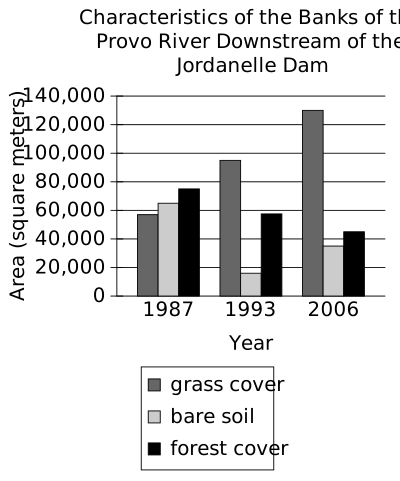
- For each data category, the following bars are shown:
- grass cover
- bare soil
- forest cover
- All values are approximate.
- The data for the 3 categories are as follows:
- 1987:
- grass cover: 57,000 square meters
- bare soil: 65,000 square meters
- forest cover: 75,000 square meters
- 1993:
- grass cover: 95,000 square meters
- bare soil: 16,000 square meters
- forest cover: 57,500 square meters
- 2006:
- grass cover: 130,000 square meters
- bare soil: 35,000 square meters
- forest cover: 45,000 square meters
- 1987:
The Jordanelle Dam was built on the Provo River in Utah in 1992. Earth scientist Adriana E. Martinez and colleagues tracked changes to the environment on the banks of the river downstream of the dam, including how much grass and forest cover were present. They concluded that the dam changed the flow of the river in ways that benefited grass plants but didn’t benefit trees.
Which choice best describes data from the graph that support Martinez and colleagues’ conclusion?
Explanation
Choice D is the best answer because it describes data from the graph that support Martinez and colleagues’ conclusion that the Jordanelle Dam led to changes that benefited grass plants but not trees. The graph shows characteristics of the banks of the Provo River downstream of the Jordanelle Dam in three different years—1987, 1993, and 2006. Specifically, the graph shows the amount of grass cover, bare soil, and forest cover in those years. The text indicates that the Jordanelle Dam was built in 1992, meaning that the data from the graph for 1987 reflect conditions before the dam was built, whereas the data for 1993 and 2006 reflect conditions after the dam was built. The data show that grass cover increased substantially from 1987 to 1993 and again from 1993 to 2006. The data also show that forest cover declined over those periods. Together, these data support Martinez and colleagues’ conclusion that the dam was beneficial for grass plants but not for trees—grass cover increased significantly after the dam was built, while forest cover declined.
Choice A is incorrect. Although it is true that, in the graph, the lowest value for grass cover is approximately 58,000 square meters and the highest value for forest cover is approximately 75,000 square meters, both values are from 1987, before the Jordanelle Dam was built in 1992. Therefore, this information alone cannot support Martinez and colleagues’ conclusion about changes in grass and tree cover following the construction of the dam. Choice B is incorrect because it presents an inaccurate description of data from the graph. The graph shows that there was more forest cover than grass cover in 1987, not that there was more grass cover than forest cover that year. Choice C is incorrect because, while it accurately reflects data from the graph when it compares grass cover and forest cover to bare soil, these data alone cannot support Martinez and colleagues’ conclusion that the dam led to changes that benefited grass plants but not trees. An increase in grass cover relative to bare soil following the construction of the dam might indicate that the dam benefited grass plants, but the fact that there was more forest cover than bare soil in all three years doesn’t indicate that the dam failed to benefit trees.